μPharma: A Platform for Rapid, Personalized Prediction of Cancer Drug Response
Salt Lake City, Utah — Researchers at the University of Utah have developed a next-generation platform that could change how aggressive leukemias are treated. The system, called μPharma, uses advanced microfluidics and artificial intelligence to predict how individual cancer cells will respond to therapy in just a few hours.
Aggressive leukemias such as pediatric T-cell acute lymphoblastic leukemia (T-ALL) often have few effective treatment options and high rates of relapse. Current approaches to test drug response can take days or weeks. μPharma aims to accelerate that decision process, offering clinically relevant insights in the same day that patient cells are collected.
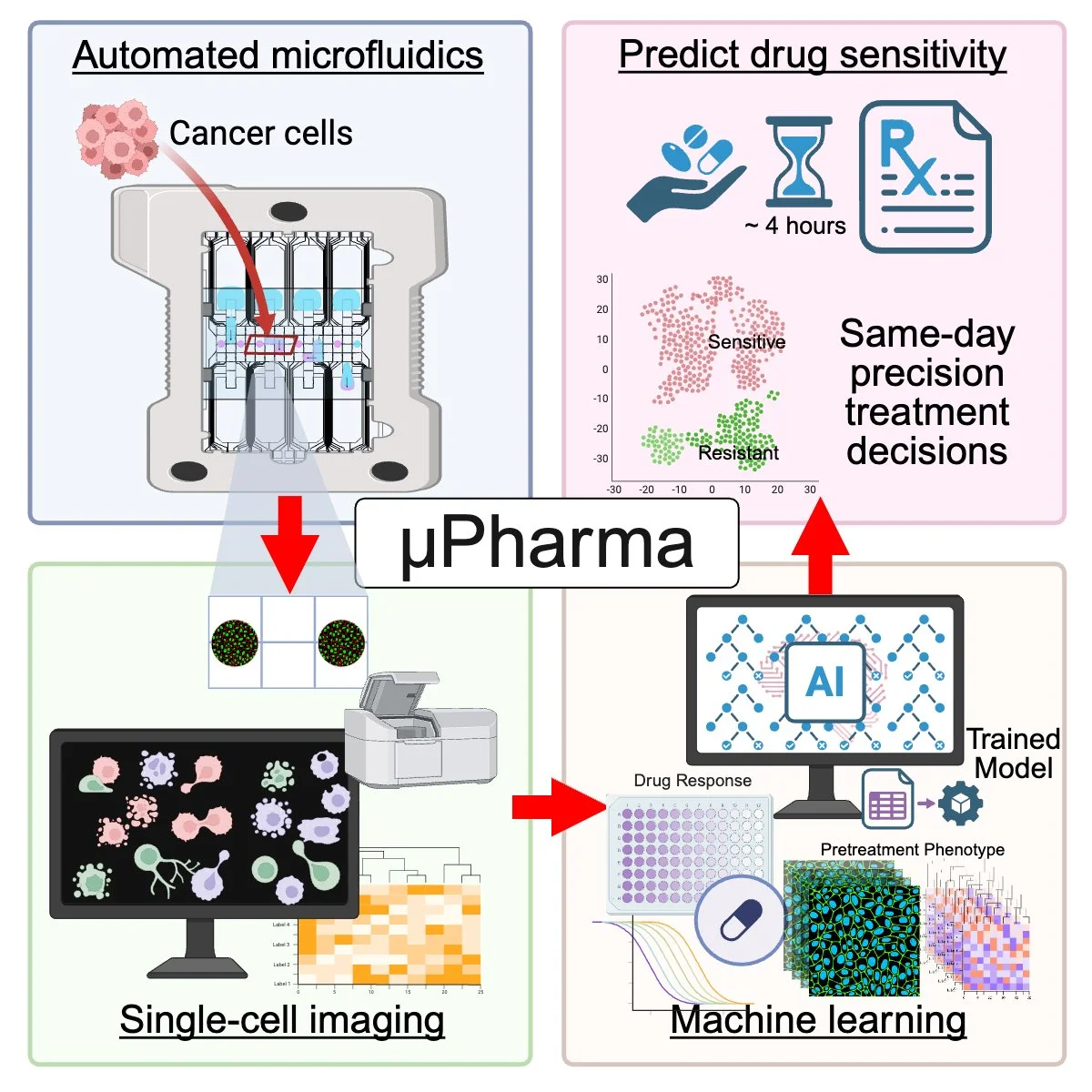
TOC graphic reproduced from Hu et al., Med (Cell Press), 2025. Yue Lu, PhD; Alphonsus Ng, PhD. University of Utah.
What is μPharma?
μPharma is an AI-driven pharmacotyping platform that analyzes protein biomarkers from thousands of individual cancer cells. Rather than exposing cells to drugs and waiting for cell death, μPharma uses automated microfluidics and machine learning to interpret subtle protein and morphological signals that indicate sensitivity to specific treatments.
Rapid Results, Minimal Sample
In our newly published study in Med, μPharma demonstrated proof of principle in T-ALL using cell lines and patient-derived samples. The platform accurately predicted sensitivity to targeted agents such as dasatinib and venetoclax by measuring key protein pathways, including LCK and BCL2 signaling. Importantly, it did this without direct drug exposure and in approximately four hours, using only minimal cell input.
Collaborative Effort Across Institutions
This work was carried out in collaboration with scientists and clinicians at St. Jude Children’s Research Hospital and the Children’s Hospital of Philadelphia, alongside teams at the University of Utah. The interdisciplinary effort brings together engineering, data science, and pediatric oncology to tackle one of the toughest challenges in cancer treatment.
Why This Matters
Rapid turnaround — actionable insights from patient cells in hours
Precision — single-cell resolution captures tumor heterogeneity
Generalizable — platform framework could be adapted to other cancers
Read the Full Paper
The article is published in Med and available now.